Wallet of Satoshi Alternative: Rizful
Wallet of Satoshi is the best known Lightning wallet. If you're looking for an alternative, here's an honest comparison with Rizful. We make Rizful, so we've kept to things you can check yourself: every claim about Wallet of Satoshi below links to its own page, each read on November 9 or 10, 2026, and we sent real bitcoin both ways between them (November 10, 2,000 sats each way; what it cost).
Wallet of Satoshi is better at some things, and Rizful at others:
| Wallet of Satoshi | Rizful | |
|---|---|---|
| Lightning Address | A random one straight away. A custom one after 10 Lightning payments and 100,000 sats moved on-chain | The one you choose, from the start. Up to fifteen in one account, each with its own balance |
| Receive over Lightning | Free | Free |
| Send over Lightning | Our 2,000-sat send cost 14 sats. No fee of its own, just routing; on a Spark wallet, Spark's 0.25% + routing | Our 2,000-sat send cost 11 sats: 0.1% + routing |
| Receive on-chain | 1.95% | Nothing |
| Send on-chain | 1.95% + a fixed fee | On our 10,000-sat send, 50 sats + a 705-sat network fee |
| Where it runs | A phone app, iPhone and Android, only from the App Store and Google Play | Any web browser: phone, tablet or computer |
| Apps and websites | No business API | Connects to other apps with an NWC code, and to your website with OpenReceive |
| Shop counter | A point-of-sale app | Not a separate app; a receive-only code works with a website or app checkout |
| A dollar balance | Yes, in supported regions | No |
The Lightning Address
A Lightning Address looks like an email address, and anyone can pay it from any Lightning wallet. Both wallets give you one.
Wallet of Satoshi gives you one the moment you install it, with a randomly generated name.
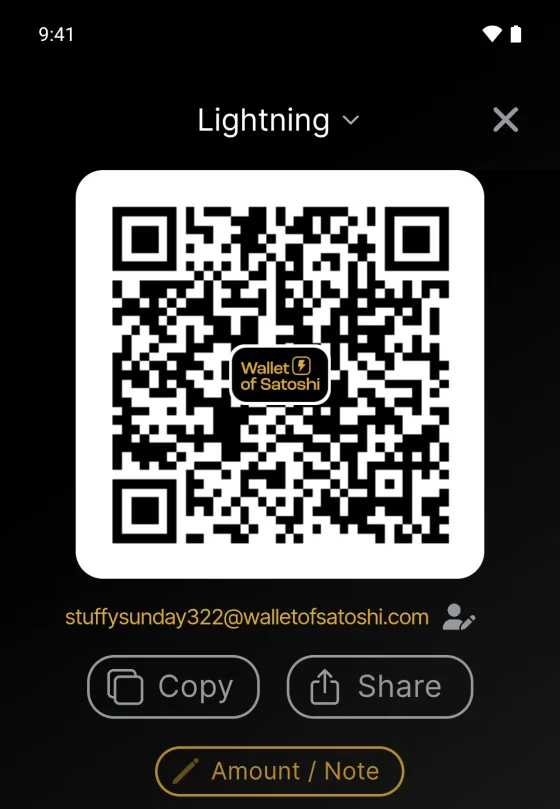
You can choose your own, but only once you've used the wallet enough: at least 10 Lightning payments, and at least 100,000 sats moved on-chain. At its on-chain fee of 1.95%, moving those 100,000 sats would cost you about 1,950 sats.
Rizful lets you choose your name from the start: a new account's address has a pencil beside it, and any address can be changed in Menu > Settings > Change Lightning address. Type a name and save it.
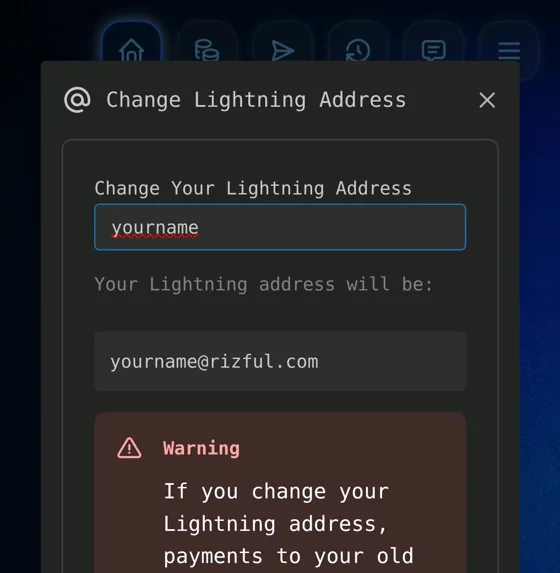
One account can have up to fifteen addresses, each with its own balance and ledger. How to set up your address.
The Fees
Receiving over Lightning is free on both. Sending is where they differ, and the answer depends on which wallet you get.
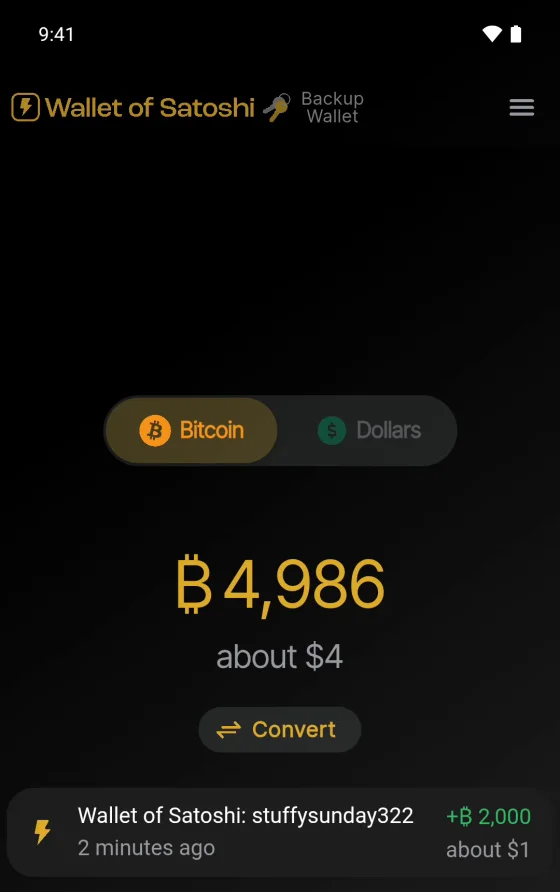
What it cost us. On November 10, 2026 we sent 2,000 sats each way between our own two wallets, a few minutes apart. Each wallet's own record:
| Wallet of Satoshi to Rizful | Rizful to Wallet of Satoshi | |
|---|---|---|
| Sent | 2,000 | 2,000 |
| Fees | 14 ("Total Fees" in Wallet of Satoshi) | 11: Rizful's platform fee (0.1%) 2, routing 9 |
| Received | 2,000 | 2,000 |
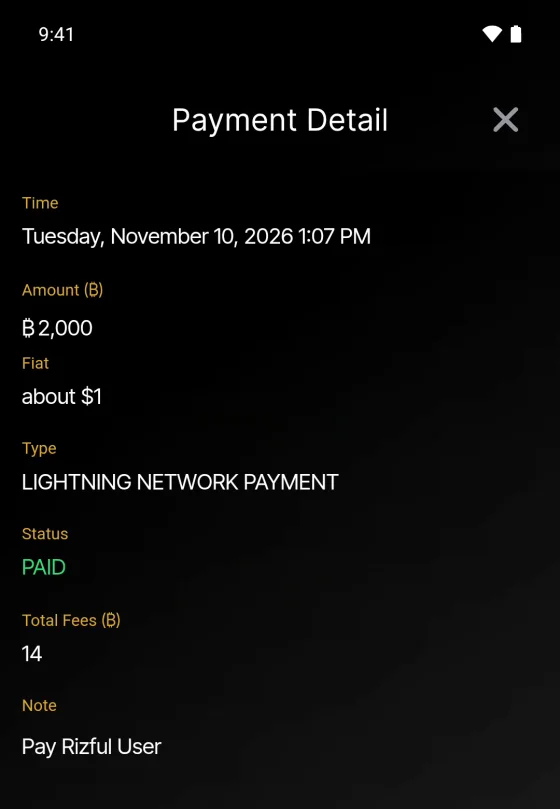
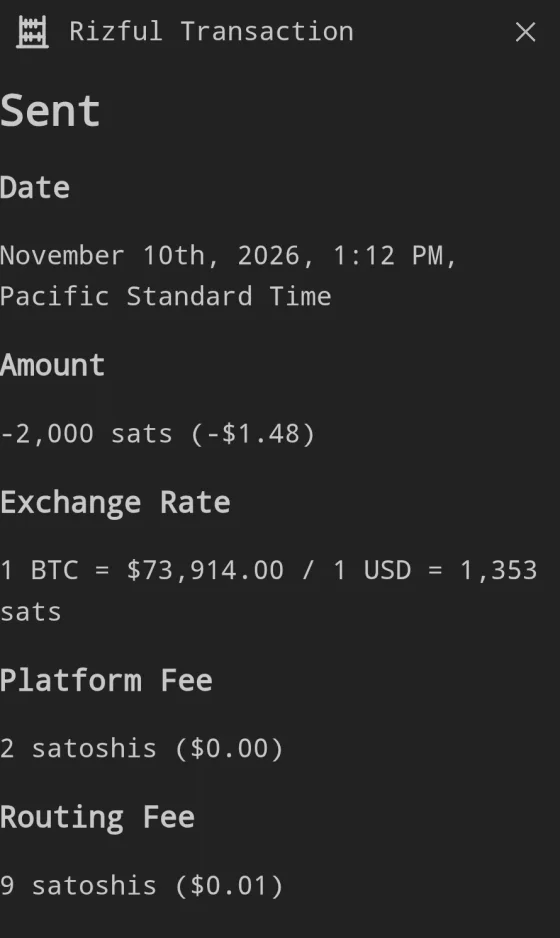
Both sides received the full amount: Rizful's balance went up by 2,000 sats, and so did Wallet of Satoshi's.
- Rizful charges 0.1% to send, plus Lightning routing fees, and receiving is free.
- Wallet of Satoshi says it charges no fees of its own for Lightning. There may be a small routing fee, which goes to the nodes that carry the payment.
- But depending on your region, a Wallet of Satoshi wallet may run on Spark. Its Disclosure Document says "Spark may impose its own fees for certain transactions", and Spark's FAQ lists them: 0.25% + routing fee from Spark to Lightning, and for a Lightning payment into a Spark wallet, "Free for the receiver. 0.15% for the sender (charged on routing nodes)".
So for the same 2,000 sats on the same day, Rizful cost us 11 sats and Wallet of Satoshi 14. Wallet of Satoshi's record shows one total, so we can't say how its 14 split between Spark and routing. Routing fees change from one payment to the next, so take these as one real example each, not a price list. On a Wallet of Satoshi wallet without Spark, you'd pay routing only.
On-chain:
- Wallet of Satoshi charges 1.95% on bitcoin received to an on-chain address, and 1.95% plus a fixed fee to send on-chain.
- Rizful charges nothing to receive on-chain, and when we sent 10,000 sats on-chain on November 5, 2026, the fees were 50 sats plus a 705-sat network fee.
Where Each One Works
Wallet of Satoshi is a phone app for iPhone and Android. Its only official versions are on the App Store and Google Play. Its list of countries (last updated March 2024) has 176 on Android and 173 on iPhone. For shop counters it has its own point-of-sale app, and it can hold a US dollar balance in the regions that support it. It doesn't offer a business API.
Rizful runs in any web browser, on a phone, a tablet or a computer: the same account everywhere. On a phone you can add it to your home screen, so it opens like an app. Its terms name the sanctioned places it can't be used. It also connects to other apps through Nostr Wallet Connect, and for a website or an online shop it gives you a receive-only code for OpenReceive, the safe way to receive bitcoin and stablecoin payments for websites and apps. That code can take payments in, but it can never spend them.
For more on what runs underneath Wallet of Satoshi, see why it isn't on our list of the best Lightning wallets.
If You Want Your Own Node
Neither of these is for you if you want to run your own Lightning node and open your own channels. For that, use Alby Hub: it's free, it runs on your own computer or a server, and it suggests Megalith as your channel partner. Our list of the best Bitcoin Lightning wallets covers it and the rest.
Which One Should You Use?
- Wallet of Satoshi, if you want the simplest possible phone app and you don't mind a random address for a while.
- Rizful, if you want the address you choose from day one, on any device, connected to your apps and your website.
- Alby Hub, if you want your own node and your own channels.
Sending to an exchange, or anywhere that only takes on-chain bitcoin? Check that wallet's on-chain fee first: this is where the two differ most.